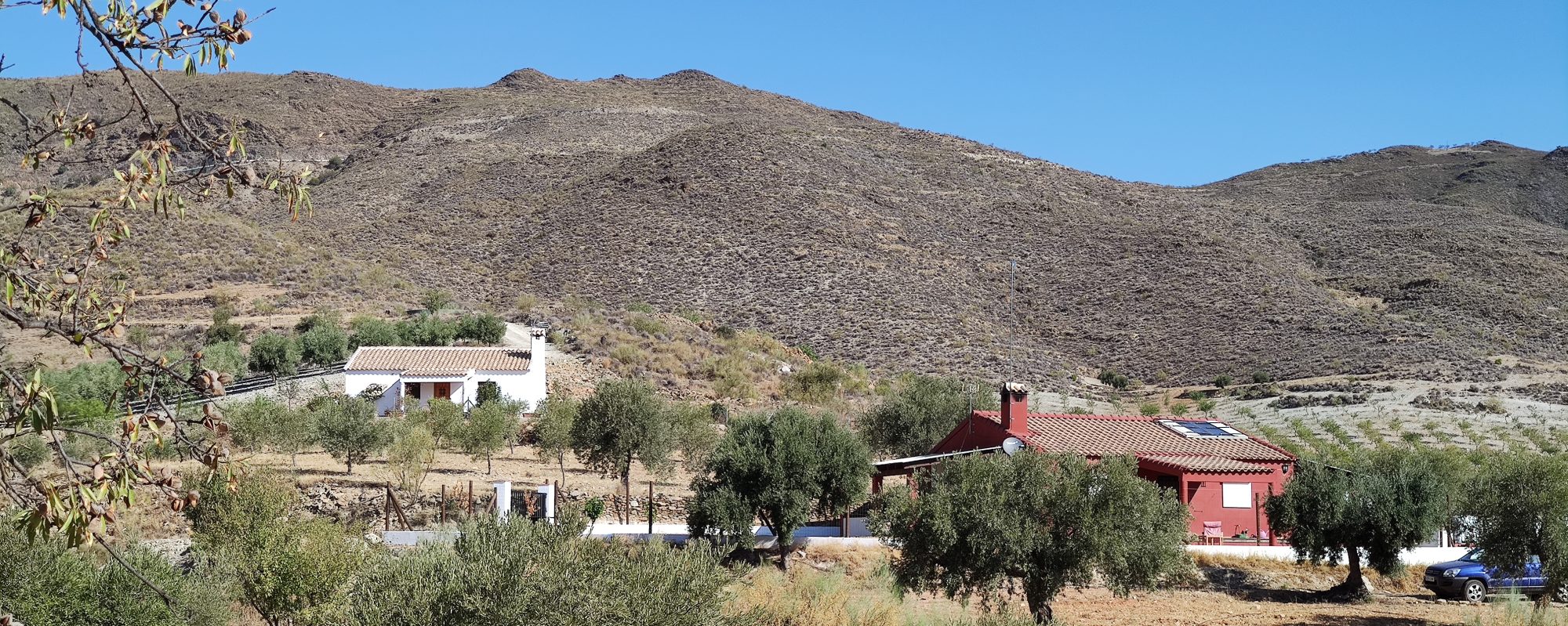
Olive farming is generally quite easy, and our land in total (1 hectare and 100 trees) is manageable between 2 people. We took the olives on with absolutely no knowledge, just a wish to look after them. It’s taken us 5 years to get them into shape after a long time being unloved and unirrigated.
Our olive types
Our olives are a mixture of Lechin de Granada (also called El Pais) and Picual. The older mature trees are El Pais and the young ones in ‘Mary’s plot’ are Picual. The El Pais are a very robust hardy tree which are very drought and pest tolerant. They produce a very smooth golden oil. The Picual produce a larger olive which is best harvested green and this has a more spicy greener oil.
Pollination
Olives are mainly wind pollinated, which is why annual pruning and opening out the trees is very important. It allows wind flow for the pollen to disperse and also protects against moisture-loving pests and diseases. We have many bees here too which help, thanks to the local Bee Man with his hives halfway up the hill behind us. He also moves the hives around in good years so you can occasionally see them pop up further down the valley.
Harvesting tools
- Olive nets – robust polypropylene, these come in various sizes. Ours are 7m and 4m and they’re usually available from every ferreteria. We need 2 big ones overlapping for the mature trees. We use the 4m ones (x2) for the small trees or sometimes we can use one big one.
- Olive combs and poles – we harvest the old fashioned way with hand-held olive combs, or combs fixed to poles of various lengths. It takes much longer than the electric or petrol harvesters but is much kinder to the trees.
- Lopper – we have a long lopper which we use to get at high branches to remove them when pruning, and a couple of shorter loppers.
- Secateurs – hand pruning of small suckers.
- Wood saw – handy for removing any larger branches.
Irrigation
- Irrigation pipe – comes in various widths with various fittings. The pipe comes out of the tanks/well at about 40 or 50mm but the pipe serving the olives is 15mm.
- Pipe connectors – the connectors do exactly what they say – we use them mainly to connect lengths of pipe after repairs. The rabbits sometimes chew the pipes to get at the water so we will cut the pipe where its damaged and connect the 2 pieces. Or insert a new length of pipe using the connectors.
- Pipe taps – these allow you to control water flow but importantly you can isolate any areas of pipe you want to work on even if irrigation is in progress.
- Irrigation filter – inserted in the pipe to draw out any particles which clog the nozzles
- Nozzles – we have orange nozzles inserted into the pipe to feed water to each tree. We use 3 nozzles per tree for the mature trees and one nozzle per tree for the young trees.
The olive year in brief
January – Pruning. At this time of year the olives are dormant after the harvest and during the colder weather. This is the best time for general pruning. We remove all the new ‘sucker’ growth, particularly off the top of the tree, remove dead branches and twigs, remove redundant old branches and overgrowth, and remove any crossing branches. The aim is an olive tree with an open champagne glass shape and arching branches – a bit like a weeping willow. The cropping growth should be within easy reach of a person using a stepladder, a medium or long pole and an electric agitator.
Feb/March – fertilising. We use organic liquid fertiliser and a product called Supersoil, which is a soil microbe enhancer. We put this on the trees before rain is forecast, most often in late Feb and early March. Supersoil takes about 6 weeks to reach maximum microbe strength so early March is ideal for the olive flowering in May.
May – flowering season. Olives produce fronds or skeins of tiny white flowers which are not showy like the almonds (which flower earlier and are insect pollinated). Because olives are wind pollinated what you want is a nice wet March and April, followed by a dry May. Heavy rainfall during the olive flowering period will drop the pollen out of the air and massively reduce your crop.
June – fruit sets and starts to develop
July or August – sucker removal. The olive tree’s natural habit is actually a bush so it sprouts suckers from the base and trunk. These are removed usually with secateurs and loppers so the tree can stay a nice tree-shape, and concentrate its efforts on the fruit.
July to September/October – irrigation. When the hot season starts, the olives need to be watered once a week to maintain the crop. Under-watering will lead to wizened fruit and dropping of fruit early. Once a week we start the well pump to the olives, then walk round and check the pipes and nozzles for problems. Nozzles can get blocked so if they’re not flowing freely, you remove the orange cap, clear it, clear the hole in the pipe that feeds it, replace the cap and try not to get soaked in the process! We normally water for about 3 hours every week.
November/December – harvesting. The fun, rewarding and hard work bit. Ripening of the olives depends on the amount of rainfall, sunshine and temperature and differs a little each year. Generally the olives will be ready in mid-November to mid-December. The El Pais will start to turn from green to red to purple and are best harvested when there’s a good mix of these colours on the tree. The picual are best harvested green and early – it’s a lower oil yield but the oil is the best quality. If you leave harvesting too late you will start losing a lot of fruit. Hitting the right time is can be tricky but it’s better to go too early than too late. You lay the nets out under each tree then comb or agitate off the fruit. Olives like to hide their fruit so you need to look at the tree from every angle to get them all. Then you collect up the olives, trying not to trip over the net and roll them all into a convenient collection point. They go into olive crates or sacks then off to the press.
November/December – pressing. We use a local olive press that presses their own estate first, and then opens to the public. Every 3 days we take what we’ve harvested to be weighed and tested and pressed. We’re a small enterprise and we don’t get a big enough yield to get our own dedicated pressing. We therefore get back a blended oil which is mostly a mixture of El Pais, Picual and Arbequina varieties. On average we get 1 litre of oil from every 6 kilos of olives.
January – PRUNING! It’s not that time of year again already is it?
 Casa roja almeria